
Why Choose an Inflatable Air Dancer for Your Business?
An inflatable air dancer can make a storefront easier to spot without adding a permanent sign. Its bright fabric moves above the entrance, catching attention from passing cars and pedestrians. Setup is usually straightforward: secure the base, connect the blower, and check the fabric before opening. The movement is hard to miss. It can also give a promotion a more playful feel.
As an illustrative industry perspective, rather than a verified quotation, inflatable-display specialist Jordan Lee might put it this way: “An air dancer earns attention through movement, but the message still has to be clear.” That distinction matters. A well-placed display can draw eyes toward a sale, grand opening, or service counter. Yet it cannot fix unclear offers, poor placement, or a crowded storefront. It needs room to move and a message customers can understand at a glance.
There are trade-offs. Blowers need power, fabric needs care, and outdoor conditions can affect use. A display may feel less effective if it stays up for months without a fresh purpose. That is worth considering. The right choice depends on your location, audience, and maintenance routine. This guide explores what an inflatable air dancer can do for a business, where it fits best, and what to check before buying.
What an Inflatable Air Dancer Is and How It Works
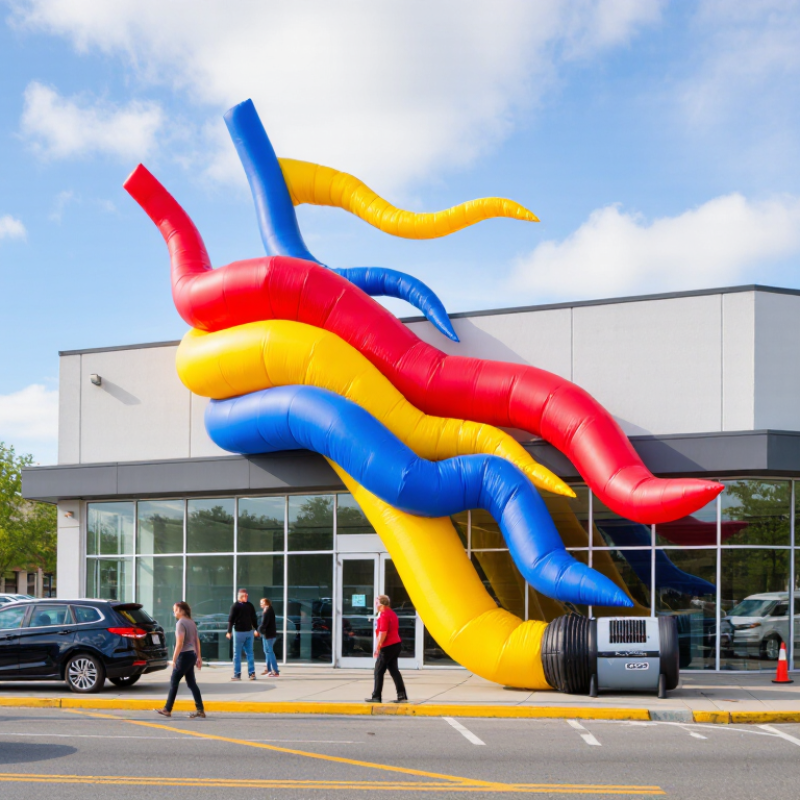
An inflatable air dancer is a tall fabric tube animated by a continuously running blower. Air enters through the base, fills the body, and escapes through openings near the top. As pressure shifts, the lightweight arms and head flap and bend. The result is movement people can notice from across a parking lot or street. Simple, but not magic.
Setup affects how well it works. Place the blower on a stable, level surface, connect the fabric securely, and keep the air intake clear. Check the unit during operation, especially in gusty weather; the fabric can twist, and the base may shift. A bright, open location helps the motion stand out, while nearby signs or trees can block the view. Movement alone cannot explain an offer, so pair the display with a short, readable message.
The Outdoor Advertising Association of America reported U.S. out-of-home advertising revenue of $9.1 billion in 2023. That figure describes the wider outdoor-advertising market, not the performance of air dancers specifically. It suggests that businesses continue to invest in visible public-facing media, but it does not prove that an inflatable will increase sales. A practical choice is to test placement and track visits or inquiries before assuming it worked.
How Its Motion and Height Improve Business Visibility
An inflatable air dancer can make a business easier to notice by combining height with constant movement. Its waving arms and shifting shape catch the eye from across a parking lot or along a busy road. A tall figure can rise above parked cars, low signs, and nearby displays, giving passersby a quick visual cue that a business is open. Motion helps, too. People often notice movement before they read a sign.
Visibility depends on placement, not just size. Set the figure where it can be seen without blocking entrances, walkways, or important signs. Check its view from a driver’s approach and from the sidewalk. On a crowded street, more height may help; in a small storefront area, it can feel overwhelming. That matters. Air dancers also need suitable power and secure installation, and wind or poor weather may affect when they can be used. The effect is useful, but it is not magic.
Tips: Choose a contrasting color that stands out against the building. Keep the surrounding area uncluttered. Check the figure regularly for stable airflow and clear visibility. A simple setup may work better than a taller one, though it can take a little testing to find the right spot.
Why Choose an Inflatable Air Dancer for Your Business? - How Its Motion and Height Improve Business Visibility
| Visibility factor | Real-world detail | How it can help a business | Practical planning note |
|---|---|---|---|
| Height above street level | Air dancers are sold in different heights; 10, 15, and 20 feet are common example sizes, but availability varies by product. | A taller display may be easier to spot over parked vehicles or street-side activity when the view is otherwise unobstructed. | Measure overhead clearance and check local rules, nearby power lines, trees, and building features before selecting a height. |
| Continuous motion | A blower pushes air into the fabric tube, causing it to inflate and move; the motion changes as the fabric bends and air flows through the system. | Movement can attract attention more readily than a stationary display, particularly in a busy visual environment. | Place it where the motion is visible from the intended approach, without obstructing walkways or drivers’ sightlines. |
| Viewing distance and angle | Visibility depends on the viewer’s distance, angle, sightline, and surrounding obstacles—not height alone. | A well-positioned display can help indicate a storefront, event entrance, or temporary promotion to people approaching the site. | Check the location from the main customer approach points at different distances before setup. |
| Wind and weather | Outdoor wind can change how an inflatable moves and can place extra load on the display and its anchoring. | Suitable conditions help keep the display operating as intended and positioned for visibility. | Follow the product’s wind limits, anchoring instructions, and weather guidance; do not use it when conditions exceed those limits. |
| Power and operating space | The blower requires a power source, and the setup needs enough clear space for the inflatable to move without contacting nearby objects. | Reliable operation helps maintain the display’s height and motion during its intended use. | Confirm the blower’s electrical requirements, use suitable outdoor electrical protection where needed, and keep the air intake unobstructed. |
| Message and visual contrast | Color and printed messaging vary by design; a message’s legibility depends on its size, contrast, viewing distance, and movement. | A simple, high-contrast message can make the display easier to recognize at a glance. | Keep wording brief and test readability from the customer’s likely viewing distance. |
Height examples are common size options, not a guarantee of availability. Check the selected product’s specifications, setup instructions, and applicable site requirements.
Where Businesses Commonly Use Inflatable Air Dancers
Retailers often place inflatable air dancers outside storefronts during grand openings, weekend sales, and seasonal promotions. Their moving shape can catch attention from across a parking lot. At a car dealership, one may stand near the entrance, away from vehicle traffic. Food markets, garden centers, and home-improvement shops also use them to draw visitors toward a display or event area. They need room. Keep the fabric clear of doors, signs, and pedestrian paths, and check that the blower has a suitable power source.
At fairs, sports events, and outdoor markets, air dancers can help identify an information booth or activity zone. Schools and community groups may use them at fundraisers, provided the setup suits the venue and event. Before installation, consider the surface, available space, weather, and any site requirements. A secure base matters; wind can make a poorly positioned display unstable. Indoors, check ceiling height and noise levels. It can distract. Not every location benefits from a moving display, especially where people need a quiet or unobstructed space. A quick site check can prevent a fun attraction from becoming an awkward obstacle.
Practical Benefits for Promotions and Customer Engagement
An inflatable air dancer gives a storefront or event entrance a moving landmark that people can spot from across a parking lot. Its waving arms and bright shape can draw attention without requiring visitors to read a long sign. That helps during a weekend sale, grand opening, or community event. Keep the message nearby and simple: a clear offer, event name, or directional arrow works better than several competing details. Small details matter. Place the figure where it is visible from the approach, but not where it blocks a doorway, sidewalk, or view of traffic.
The movement can also give staff an easy way to start conversations. A team member might greet passersby beside it, offer a sample, or point out a check-in table. The display works best as a cue, not a substitute for helpful service. It is not magic. Before opening, check the blower, power access, anchoring, and the weather guidance supplied with the unit. A steady hum may be noticeable near quiet seating, and strong wind can make outdoor use unsuitable. Those limits are easy to overlook when planning a promotion. Test the setup during business hours, watch how people move around it, and adjust the placement if it attracts attention but creates confusion.
Why Choose an Inflatable Air Dancer?
Common promotional features that can support visibility and customer engagement. This checklist shows feature availability—not measured sales or engagement results; exact features vary by model.
Factors to Consider When Choosing an Air Dancer
Why Choose an Inflatable Air Dancer for Your Business?
Factors to Consider When Choosing an Air Dancer
An inflatable air dancer can make a storefront or event entrance easier to notice from a distance. The right choice depends on more than height or color. Consider where it will stand, how much space it needs, and whether people can see it clearly from the street. A 12-foot figure may suit an open parking lot but feel overwhelming beside a narrow doorway.
Check the fabric, seams, and blower specifications before buying. Ask how the unit should be secured and whether replacement parts are available. For outdoor use, confirm the product’s stated wind limits and follow its setup instructions; never assume a heavy base alone makes it suitable for rough weather. Easy to miss. Also check the power cord’s reach and whether the blower’s sound is acceptable near customers.
Match the design to your audience and the message you want to display. Large, high-contrast graphics are usually easier to read from across a lot, while small text can disappear in motion. Think about storage, too: a compact packed size matters if the display will move between locations. I would not choose by appearance alone. A striking figure can still be awkward to install, and it can wobble.