
China Best Inflatable Santa Claus Manufacturers for Sale

An Inflatable Santa Claus can turn a quiet shop entrance, hotel lobby, or garden into a clear holiday focal point. In China, manufacturers offer designs in different heights, fabrics, lighting styles, and levels of customization. Choosing a supplier takes more than comparing product photos. A bright red suit may look convincing online, but the seams, fabric weight, and base stability matter once the decoration is inflated outdoors.

This guide explores what buyers should examine when comparing China-based Inflatable Santa Claus manufacturers for sale. Look for clear product specifications, recent production photos, and practical answers about blower capacity, repair patches, packaging, and setup. Ask whether the sample matches the final order. Small details count. A loose cable cover or undersized anchor point can cause frustration during installation. For outdoor displays, request information about weather suitability and recommended anchoring rather than relying on broad marketing claims. For indoor use, consider noise, ceiling clearance, and access to a power outlet.

Experienced suppliers should explain their materials and production process without making guarantees they cannot support. Buyers can also request a sample, confirm customization details in writing, and clarify lead times before placing a larger order. These steps do not remove every risk. A sample may not reveal how a decoration performs after weeks of use, and shipping schedules can shift during peak season. Careful questions, specific records, and realistic expectations make supplier comparisons more useful—and help ensure Santa arrives looking cheerful, not leaning sideways.
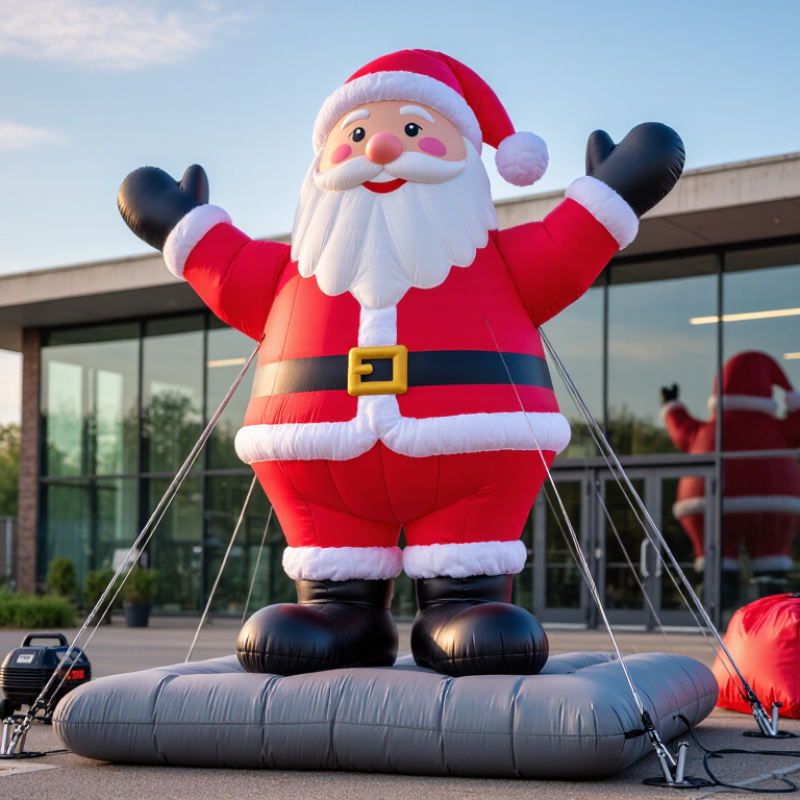
China Best Inflatable Santa Claus Manufacturers for Sale

China Inflatable Santa Manufacturers: Product Types and Export Supply Chains

China’s inflatable Santa manufacturers typically offer tabletop figures, porch-size Santas, tall yard displays, and illuminated designs. Larger models use stitched polyester or Oxford fabric, internal LED strings, a blower, and sandbag pockets. Some include waving arms or projecting legs, but extra movement means more seams and potential repair points. Small details matter. Ask for packed dimensions, blower voltage, fabric weight, and replacement-part availability before comparing quotations.

The export chain often runs from fabric cutting and sewing to electrical assembly, inflation testing, carton packing, and port dispatch. UNCTAD’s Review of Maritime Transport 2024 reports that over 80% of world trade by volume travels by sea; bulky inflatables therefore need careful carton and container planning. The World Bank’s 2023 Logistics Performance Index ranked China 19th among 139 economies, useful context but not a promise of factory-level speed. These figures describe broad logistics, not Santa-specific exports. Request recent production photos and a sample inspection record. One weak point: printed colors and stitching can vary between batches, and factory claims alone may not reveal it.

Core Specifications: Height, Fabric Denier, Blower Wattage, and IP Rating

When evaluating China-based inflatable Santa Claus manufacturers for sale, compare the finished height with your display space, not just the product photo. A 2.4-meter figure may need extra clearance for its base, tether lines, and nearby branches. Ask for packed dimensions too; a tall display can take up surprising storage space.

Fabric denier measures yarn mass, not overall durability. A higher-denier fabric may feel heavier, but coating, seams, and stitching also affect wear. ASTM D751 describes test methods for coated fabrics, offering buyers a useful reference when requesting material details.

Blower wattage should be matched to the inflatable’s size and airflow design; more watts alone do not guarantee steadier inflation. Check the rating plate and ask how the unit performs during continuous operation.

For outdoor use, inspect the blower’s IP rating. IEC 60529 defines IP44 as protection against objects larger than 1 mm and splashing water; it does not make the entire decoration waterproof.

Tips: Request a specification sheet, close-up seam photos, and the blower’s IP label. Denier is a clue, not a verdict. A perfect spec sheet still cannot predict every gust or rough setup.

IEC 60529 IP44: Protection from 1 mm Objects and Water Splashes

When comparing inflatable Santa Claus designs, IEC 60529 IP44 is a useful detail to check. The first “4” indicates protection against solid objects 1 mm and larger; it does not mean the unit is dust-tight. The second “4” indicates protection against water splashes from any direction under specified test conditions. Useful, but limited. That distinction matters beside a porch, where wind can carry grit and light rain may reach seams.

An IP44 label should apply to the relevant electrical enclosure or tested assembly, not just one plug or fan. Ask the seller what was tested and whether the rating covers the blower, wiring, and connectors. Check the product instructions, too. Keep connectors clear of puddles, and inspect seams after setup; the fabric itself may not share the electrical rating. IP44 is not a promise of protection from heavy rain, water jets, or immersion.

For a seasonal display, place the figure on level ground and secure its tethers before switching it on. Disconnect power before moving or checking it. A detail can be easy to miss: a rated component does not make every exposed connection safe. That deserves a second look.

China Best Inflatable Santa Claus Manufacturers for Sale — IEC 60529 IP44 Protection Guide

IP44 explained: The first digit, 4, indicates protection against solid objects 1 mm and larger. The second digit, 4, indicates protection against splashing water from any direction under the applicable test conditions. Check the specific product’s test documentation to confirm its rating.

Export Power Compatibility: 120 V/60 Hz and 230 V/50 Hz Models

For inflatable Santa Claus exports, electrical compatibility is part of the product specification, not a plug-in afterthought. IEC 60038 sets 230 V as a standard low-voltage supply value, while U.S. household supply commonly uses 120 V at 60 Hz. Buyers should request separate 120 V/60 Hz and 230 V/50 Hz configurations where needed.

Check the rating label. A plug adapter changes plug shape, not voltage or frequency.

Ask manufacturers to state the blower’s rated voltage, frequency, wattage, plug type, and whether a transformer is required. The U.S. Energy Information Administration’s electricity explanations identify 60 Hz as the U.S. grid frequency; export buyers should compare this with their destination supply.

Frequency matters: a blower designed only for 60 Hz may not perform as specified on 50 Hz power. IEC 60038 is a useful reference for nominal supply voltages, but it does not replace checking the finished product’s label and manual.

Small detail. Big consequence.

A “universal” description can be vague, so request written confirmation for the exact model and destination. During production checks, inspect the plug, cord, and rating label together; one mismatched component can complicate installation.

Factory Evaluation: ISO 9001:2015, Quality Records, Samples, and Lead Times

When evaluating Chinese manufacturers of inflatable Santa Claus decorations, ask for an ISO 9001:2015 certificate and verify its validity, issuing body, and factory scope. Certification shows that a quality management system has been assessed; it does not guarantee every unit will meet your specifications. The ISO Survey 2022 reported 1,265,216 valid ISO 9001 certificates across 189 countries and economies. That scale makes verification essential. Request recent inspection records, material batch references, and corrective-action examples. Look for traceable checks from fabric receipt to packed product. Records matter.

Ask for a production sample made with the same fabric, seams, blower, and accessories planned for the order. Check seam strength, inflation stability, stitching, print alignment, and how securely the base sits on a flat floor. Photograph defects and record agreed tolerances before approving the sample. One detail is easy to miss: a carefully prepared sample may not reflect routine production. Ask how the factory compares finished units with the approved sample, and whether it keeps dated inspection results. That gap matters.

For lead times, request a written schedule that separates sample approval, production, inspection, and packing. Confirm which events could delay dispatch, including material shortages and peak-season capacity. Ask for recent, anonymized order records rather than relying on a verbal estimate. A firm date is helpful. A realistic range is better. Include time for sample revisions; this step is often underestimated, even by experienced buyers.

China Best Inflatable Santa Claus Manufacturers for Sale — Factory Evaluation: ISO 9001:2015, Quality Records, Samples, and Lead Times
Evaluation Dimension What to Request or Check Practical Screening Benchmark Verification Method
ISO 9001:2015 certification Current certificate covering the manufacturing site and relevant product or production scope. Certificate is valid, site-specific, and issued by a certification body whose accreditation can be independently checked. Confirm the certificate number, scope, site address, expiry date, and issuer through the issuer or accreditation directory.
Quality management records Documented incoming inspection, in-process checks, final inspection, nonconformity handling, and corrective actions. Records are dated, traceable to production batches, and retained under a defined procedure. Review redacted examples from recent production lots and confirm how inspection failures are recorded and resolved.
Material specifications Fabric type and thickness, coating, color specification, thread, zipper, fan, lights, and other electrical components, where applicable. Materials and components are specified before production; substitutions require buyer approval. Compare the quotation and bill of materials with supplier data sheets, labels, and the approved sample.
Sample quality Pre-production sample showing artwork, color, dimensions, seams, anchoring points, fan fit, and included accessories. Sample matches the approved specification and has passed a documented inflation and visual inspection. Request a signed sample approval record, dimension check, and photos or video of the sample operating.
Inflation and function testing Operating check for the fan, air retention, stability, lighting, and electrical connections when included. Test duration and acceptance criteria are agreed in writing and recorded for the inspected unit or batch. Ask for the test procedure and batch inspection records; verify safety documentation for electrical parts relevant to the destination market.
Production lead time Separate timelines for sample making, bulk production, inspection, and dispatch preparation. Supplier provides a written schedule tied to order quantity, artwork approval, material availability, and seasonal capacity. Request a milestone plan and confirm the start date, completion date, and process for notifying the buyer of delays.
Pre-shipment inspection Inspection plan covering appearance, dimensions, accessories, packaging, quantity, and agreed functional checks. Acceptance criteria and inspection timing are agreed before the order enters production. Use a documented checklist and retain the inspection report, defect photos, and corrective-action records.
Packaging and shipping preparation Unit packing, carton markings, packing list, product instructions, and protection against moisture or transit damage. Packaging details are approved before shipment and correspond to the order and destination requirements. Review a packaging specification, carton photos, and a draft packing list before dispatch.
Supplier communication and traceability Named points of contact, order change control, batch identification, and complaint handling process. Production changes and corrective actions are documented and linked to the affected order or batch. Ask for a redacted example of a change record and the procedure for handling quality complaints.
Use of this table This is a practical buyer-side evaluation checklist, not a claim about any specific factory or a verified supplier ranking. Confirm all certificates, records, samples, test results, and lead times directly with the supplier before placing an order.